
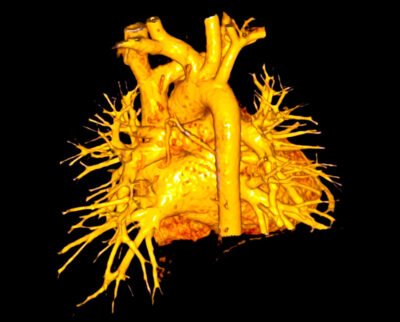
Defining Normal Ascending Aorta Size by Imaging
January 1, 2026
By Michael H. Crawford, MD, Editor
Synopsis: Two large biobank studies of the relationship between various imaging measurements of ascending aorta size normalized to several body size metrics have shown that ascending aorta area/height performs best for predicting adverse aortic events.
Source: Tavolinejad H, Beeche C, Dib MJ, et al. Ascending aortic dimensions and body size: Allometric scaling, normative values, and prognostic performance. JACC Cardiovasc Imaging. 2025;18(12):1315-1327.
Accurate assessment of ascending aorta size is important for determining the timing of early prophylactic interventions. Recent data suggest that using ascending aorta (AsAo) diameter alone is insufficient for determining the risk of adverse aortic events. Although body size is an important determinant of aortic size, how to integrate it to normalize aortic measurements is unclear. Thus, these investigators from the U.K. Biobank (UKB) and the Penn Medicine hospital system biobank (PMB) sought to determine the allometric exponents that characterize the normal relationship between AsAo dimensions and body size metrics, and to examine their prognostic performance.
Cardiovascular magnetic resonance (CMR) imaging was available in 49,282 of the > 500,000 UKB participants (mean age 55 years, 48% men) and 8,448 of the 264,194 PMB subjects (mean age 60 years, 53% men). Among these subjects, a subgroup of nonsmokers without known cardiovascular disease or risk factors for it were selected to establish a normal refence value group. Subsequent thoracic aorta events were sought in the U.K. National Health System database and the Penn Medicine clinical database and were defined as deaths or hospitalization as the result of dissection, ruptures, or emergency operations.
In both cohorts, the allometric exponents of diameter/height, diameter/body surface area (BSA), and area/BSA exhibited highly nonlinear relationships. By contrast, area/height was very close to unity (UKB: 1.04; PMB: 1.13). The linear ratio of area/height did not exhibit residual associations with height in either cohort. Also, across quintiles of height and BSA, only area/height consistently classified aortic dilatation, whereas all the other indices systematically either underestimated or overestimated AsAo dilatation at the extremes of body size.
In addition, area/height robustly predicted thoracic aorta adverse events in the UKB over a mean follow-up of 67 months (hazard ratio [HR], 3.73; 95% confidence interval [CI], 3.03-4.59; P < 0.001; C-index: 0.949) and the PMB over a mean of 103 months (HR, 1.83; 95% CI, 1.57-2.13; P < 0.001; C-index: 0.735). The relationship between the probability of thoracic aorta adverse events exceeds 5% at an area/height about 8 cm2/m and for dissection or rupture specifically at about 9 cm2/m.
The authors concluded that AsAo area/height was allometrically correct, did not have residual associations with body size, and was robustly associated with adverse thoracic aorta adverse events.
Commentary
The AsAo is the site of about 60% of thoracic aneurysms. Previous studies have shown that as the diameter of the AsAo increases, the risk of an adverse event increases exponentially. Hence, current guidelines recommend AsAo diameter cutoffs for considering aortic interventions to prevent adverse events. However, studies have shown that AsAo size is dependent on body size and have recommended that allometric scaling be used to adjust the measurement based on such metrics as BSA or height. Also, sex differences have been observed, so perhaps sex-specific cutoffs are desirable. These studies generally have been small and focused on specific risk groups and may not be applicable to the general population. Accordingly, this study based on the UKB with verification in the PMB is of considerable interest.
These biobank studies showed that there is a consistent linear relationship between AsAo area and height in men and women, whereas AsAo diameter/height or BSA was non-linear, especially after 40 years of age, had residual associations with body size, and was different for men and women. Also, the two biobank populations had nearly identical allometric exponents for area/height. This is remarkable given that compared to the UKB, the PMB population was older and had more risk factors for cardiovascular disease.
There are limitations to this biobank study to consider. The two cohorts used different imaging modalities (CMR, computed tomography). Also, it was not known whether the images were consistently electrocardiogram-gated. In addition, the precise anatomic location of the area measurements of AsAo could not be determined and the number of adverse aortic events was low in both populations. Finally, events were based on administrative diagnostic and procedural codes, which could be inaccurate. The authors suggested that future studies should be focused on identifying the best AsAo area/height cutoffs for clinical decision-making.
Michael H. Crawford, MD, is Professor Emeritus of Medicine and Consulting Cardiologist, UCSF Health, San Francisco.