
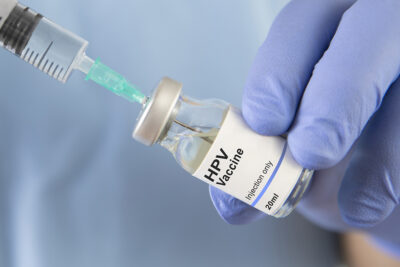
One vs. Two Doses of HPV Vaccine
January 1, 2026
By Stan Deresinski, MD, FACP, FIDSA
Synopsis: A single dose of either of two human papillomavirus vaccines was as effective as administration of two doses.
Source: Kreimer AR, Porras C, Liu D, et al. Noninferiority of one HPV vaccine dose to two doses. N Engl J Med. 2025;Dec 3. doi: 10.1056/NEJMoa2506765. [Online ahead of print].
Kreimer and colleagues evaluated the relative efficacy of two doses vs. one dose of human papillomavirus (HPV) vaccine in the prevention of cervical
cancer in Costa Rica. Two different vaccines were studied. Cervarix is a bivalent vaccine against HPV types 16 and 18 and GARDASIL 9 is a nonavalent vaccine targeting HPV types 6, 11, 16, 18, 31, 33, 45, 52, and 58. In the United States, each is recommended to be administered in three doses over six months. However, at the end of 2022, the World Health Organization (WHO) changed its own recommendation to give either one or two doses to females 9-20 years of age.
Patients (n = 20,330) were randomized 1:1:1:1 to receive one or two doses of one of the two vaccines. Six months after their initial injection, participants received either a second dose of their HPV vaccine or tetanus, diphtheria, pertussis vaccine as a blinded control. In addition to comparing outcomes for each of the four study arms, effectiveness was determined by comparing HPV16 or HPV18 infection to infection in 3,005 trial participants and in women enrolled in a non-randomized survey group.
For each vaccine, administration of a single dose proved to be noninferior to two doses. The effectiveness in prevention of HPV16 or HPV18 infection (the types most associated with cervical cancer) was > 97.1% for either one or two doses of either vaccine. The effectiveness of the nonavalent vaccine against infection with any of the seven carcinogenic HPV types (16, 18, 31, 33, 45, 52, and 58) included in the vaccine was 94.5% and 95.7% with one and two doses, respectively. Protection persisted for at least five years.
Commentary
Cervical cancer is the fourth most common cancer in women. Globally, in 2022, 660,000 new cases and 340,000 deaths resulted, mostly in low- and middle-income countries. Despite its efficacy, less than one-third of girls in the WHO target group have received HPV vaccination. Observational studies previously had suggested that single-dose vaccination results in protection similar to that of the previously recommended multiple doses, and the study discussed here unequivocally confirms this. In fact, 80 countries already have adopted single-dose vaccination, an approach that makes reaching population vaccine targets much more feasible.
Nonetheless, obstacles remain. Having provided protection to an estimated 86 million girls in low- and middle-income countries and preventing more than 1 million cervical cancer deaths, Gavi, the Vaccine Alliance, is about to lose one-fourth of its funding.1
Stan Deresinski, MD, FACP, FIDSA, is Clinical Professor of Medicine, Stanford University.
Reference
1. Kirby T. Gavi hits HPV vaccine milestone early but concerns surround future funding. Lancet Oncol. 2025;Nov 27:S1470-2045(25)00712-0. doi: 10.1016/S1470-2045(25)00712-0. [Online ahead of print].